The Washington Postreported Tuesday that among those agitating protesters in Baghdad on Tuesday was Hadi al-Amiri, a former transportation minister with close ties to Iran who leads the Badr Corps, another PMF militia.
In 2011, both Fox News and the Washington Times noted that then-Iraqi Prime Minister Nouri al-Maliki brought his transportation minister, al-Amiri, to a meeting at the White House. The Times noted that the White House did not confirm his attendance, but the official was on Iraq’s listed members of its delegation.
The al-Amiri accompanying al-Maliki, besides also being transportation minister, was identified at the time as a commander of the Badr organization, further indicating it was the same person. At the time, the outlets expressed concern that al-Amiri had ties to the Iranian Revolutionary Guard Corps (IRGC), which the FBI has stated played a role in a 1996 terrorist attack that killed 19 U.S. servicemen. President Donald Trump designated the IRGCa foreign terrorist organization, the first time an official arm of a foreign state received the designation.
Fox News’ Ed Henry questioned White House Press Secretary Jay Carney following the visit about the attendance of al-Amiri at the White House. Carney refused to answer and stating that he would need to investigate the issue. The full transcript from RealClearPolitics reads:
Ed Henry, FOX News: When Prime Minister Maliki was here this week there have been reports that a former commander of the Iranian Revolutionary Guard, which U.S. officials say played a role in a 1996 terrorist attack that killed 19 U.S. servicemen.
He was here at the White House with Prime Minister Maliki because he’s a transportation minister, yeah, transportation minister —
Jay Carney, WH: Who’s [sic] report is that?
Henry: I believe the Washington Times has reported it. I think others have as well, but I think this is a Washington Times —
Carney: I have to take that question then, I’m not aware of it.
Henry: Can you just answer it later though, whether he was here and whether a background check had been done?
There long has been worldwide concern over the issue of the Palestinian
Authority paying salaries to terrorists
Here’s the full article-
Ilhan Omar – commits treason with official support for a terrorist – she is in an OFFICIAL capacity siding with the enemy, providing them aid and comfort
The UN has become a terrorist supporter
Hypocrisy at it’s best: Top United Nations official declared the U.S. airstrike
on Iranian terror mastermind Qassem Suleimani “unlawful,” saying it
“violates international human rights law,” and she threatened U.S. officers
with “individual criminal liability.”
AGNES CALLAMARD
PRESIDENT TRUMP RESPONDS
IRGC-responds
Soleimani’s death unfurls the RED Flag over the Holy Dome Of Jamkarän Mosque, Qom Iran. First Time In The History! Red Flag: A Symbol Of Severe Battle To Come.
And Benghazi attacks were Soleimani’s too
President Trump didn’t start the war. Iran did. Soleimani worked for IRAN. THE gov of Iran, not just some wayward group of terrorists. THE gov!!!!!
He was also a guest at the Obama White House
US Embassy in Iraq attacked by protesters – update2 – Leader of Protests, IRGC terrorist, Visited the OBAMA WHITE HOUSE
US Embassy in Iraq attacked by protesters – These “protests” are NOT “spontaneous” – think Benghazi
Because these reports seem to disappear, I have documented some tweets off Twitter and CNN’s live coverage. I have documented the addresses and acknowledged everything that I could find. Again, this is just to keep record.
This attack has the smell of Benghazi. The “protestors” are Iranian supporters. The governments heads seem to be working for Iran.
There doesn’t seem to be much chaos or confusion or, for that matter, scatteredness with the protestors. They seem to be somewhat coordinated. Note that the “protestors” are carrying signs and flags that seem to be NEW and printed FOR this occasion. These are not last minute signs. There seem to be ALOT of “reporters” and people videoing whats going on.
Check out the signs. These are NEW and PRINTED. Not hand written. How did they know this was going to happen?
How did the reporters know? How come there are THAT many reporters there?
AOC casting call- Documenting this in her own words
full video –
Here’s some extra video links – these are with commentary
Here the commentary says that it was the young Turks, but I believe that that is only a small affiliate
Here’s an additional link to commentary
However, the main character that made “casting calls” for political events popular was Soros. His non profit groups had created these movements with ANTIFA and other protestors
The flyers were printed and distributed. They were published in Craig’s List and other places in local papers and online as well as social media
And here’s a link to an article I commented and linked previously – regarding Soros and the UN advertising for illegal migration to the US and using US TAX dollars to “aid” this treason.
FBI Informant In Trump Campaign Made Secret Recordings That Cleared Papadopoulos, Page In ‘Spygate’
(USAFeatures.news) The FBI’s insertion of an informant into the 2016 Trump campaign to spy on the candidate’s advisers and associates did not produce anything useful, according to the Justice Department’s inspector general report, which, for the first time, disclosed bits of secretly recorded conversations.
The Washington Times reported that the IG documented FBI dispatched several unnamed FBI informants to spy on Trump campaign associates who were known as confidential human sources (CHS).
The most publicized of these was Cambridge University Prof. Stefan Halper, a longtime national security operative. He ingratiated himself to George Papadopoulos and Carter Page while also trying to engage a senior Trump campaign official in New York City, the Times reported, citing the IG.
IG Michael Horowitz’s Dec. 9 report notes that instead of hearing incriminating evidence and statements, Halper — who the IG did not identify — recorded conversations that could actually have exonerated Page and Papadopoulos.
Horowitz criticized the FBI for failing to include those recordings in four sworn affidavits that were presented to the Foreign Intelligence Surveillance Act (FISA) court in order to obtain spy warrants on Page.
In his book “Deep State Target,” Papadopoulos, a Trump campaign adviser, recounted how Halper contacted him by email “out of the blue” with the promise of a $3,000 energy study if he came to London.
Halper introduced him to Azra Turk, whom he described as an office assistant.
Page was invited to a Cambridge conference where he met Halper in early July, weeks before the FBI formally launched its “Spygate” probe, called Crossfire Hurricane. They engaged in follow-on discussions at Halper’s farm in Virginia.
In the spring of 2016, Papadopoulos met another professor, Joseph Mifsud, who held academic positions in London and Rome. Following a panel discussion in Russia, Mifsud told Papadopoulos he heard that Moscow had incriminating emails about Hillary Clinton.
A month later, Papadopoulos relayed that information over drinks to an Australian ambassador. Following the release of stolen Clinton and DNC emails, the Australian government notified the FBI and in late July 2016, Crossfire Hurricane was launched.
Citing what appears to have been a set-up, Attorney General William Barr has said the FBI launched its probe on flimsy grounds, which prompted him to appoint U.S. Attorney John Durham to investigate the probe’s origins.
“To lead to the conclusion that it showed knowledge of a later hack into the DNC [Democratic National Committee] was a pretty aggressive conclusion,” Barr told Martha MacCallum on Fox News’ “The Story” last week.
“I just think that by the time the president entered office — around that time — [it was] becoming clear that there was no basis to these allegations not just the [Christopher Steele] dossier falling apart, but the information that they were relying on as to Page and to Papadopoulos,” he added.
According to the IG report, Papadopoulos reported to Halper that he knew the Trump campaign was not colluding or cooperating with Russia over the Clinton emails or for any other purpose.
He told Halper “campaign, of course, [does not] advocate for this type of activity because at the end of the day it’s … illegal,” according to the IG report.
He also said “our campaign is not. … engag[ing] or reaching out to WikiLeaks or to the whoever it is to tell them please work with us, collaborate because we don’t, no one does that …”
Papadopoulos also told Halper that he knew “for a fact” the campaign had no role. Papadopoulos also said that “as far as I understand … no one’s collaborating, there’s been no collusion and it’s going to remain that way.”
The fact that our TAX money was given to foreign invaders is and should be classified as the HIGHEST form of treason. What punishments were dealt to MOB bosses? The MOB was a domestic terror. Soros is an enabling foreign agents to ILLEGALLY invade our country.
Everyone has seen the invaders with bags with USAID on them. That is courtesy of Soros and he used YOUR tax dollars to give them those bags. He is using OUR TAX money to fund his TREASON!!!
How Soros Used US Tax Dollars to Consolidate Power in Colombia
In a recent letter to Secretary of State Rex Tillerson, six U.S. Senators asked for an investigation into whether the United States Agency for International Development was promoting the Open Society Foundations’ left-wing policies abroad.
State Department career officials gave the senators the runaround, but if Tillerson does launch the probe, he need look no further than Colombia.
That South American country offers plenty of evidence that U.S. tax dollars are indeed being used to advance George Soros’ agenda—all under the banner of “peace.”
In November 2016, Colombian President Juan Manuel Santos signed a “peace agreement” with the Marxist narco-terrorist group FARC. Though Colombians had earlier rejected the deal in a plebiscite, Santos and the Congress—which his party controls—found a loophole to ratify it, placing it above the Constitution.
The effect of this is that Santos now virtually rules by decree, answering only to an oversight commission—a junta comprised of three terrorists, three Santos cronies, and a few foreign observers.
The separation of powers has been abolished and a new peace tribunal, known as the Jurisdiccion Especial para la Paz has replaced the nation’s courts.
This act to circumvent Colombia’s Constitution was supported by many outside interests, including Scandinavian countries and the Nobel Committee, which awarded Santos the Peace Prize.
Also supportive was the Obama administration—partly through USAID—and Soros-backed nongovernmental organizations, which jointly helped launder the image, atrocities, and fortune of the world’s leading cocaine cartel.
I asked a USAID official last month whether USAID and the Open Society Foundations were coordinating in Colombia. He answered: “USAID is not funding any activities with Open Society in Colombia, directly or through any past or existing mechanism.”
But just scratching the surface of USAID activities tells a different story.
For example, Verdad Abierta, a web-based portal created by Teresa Ronderos, director of the Open Society Program on Independent Journalism, boasts on its website that it receives support from USAID.
Abierta has helped rewrite Colombia’s history, elevating terrorists to the same level as the legitimate police and military forces, and rebranding decades of massacres, kidnappings, child soldiering, and drug trafficking by a criminal syndicate as simply “50 years of armed conflict.”
Fundacion Ideas para la Paz, once led by peace negotiator Sergio Jaramillo, now a member of the oversight “junta,” is funded by the Open Society Foundations and has received more than $200,000 in U.S. tax dollars.
The left-wing news portal La Silla Vacia, another Open Society initiative, also boasts of being a USAID grantee. Its columnist, Rodrigo Uprimny, whose NGO DeJusticia also partners with USAID and Open Society, is considered one of the architects of the peace deal.
Former National Liberation Army terrorist Leon Valencia—Open Society collaborator and grantee—has received at least $1,000,000 in USAID funding through his NGOs Corporacion Nuevo Arco Iris and Paz y Reconciliacion, and left-wing news portal Las Dos Orillas, which he co-founded.
The list goes on. I’ve written in a separate piece about the long history of collaboration between Soros-funded NGOs and the U.S. State Department to undermine Colombia’s institutions, particularly through the work of Human Rights Watch.
While terrorists are rewarded with unelected seats in Congress and impunity, those who combated them will either confess to crimes they haven’t committed or go to jail.
This leads to Soros’ crowning achievement: Of the five commissioners chosen to select the judges for the new peace tribunal, three are key players in Soros’ network.
Diego Garcia-Sayan is chairman of Open Society’s Global Drug Policy Program, Juan E. Mendez is a 15-year veteran of Soros-funded Human Rights Watch, and Alvaro Gil-Robles collaborated with Open Society on the issue of Roma rights, eventually leading to the creation of the European Roma Institute—a joint initiative of the Open Society Foundations and the Council of Europe.
I recontacted USAID with follow-up questions regarding all the above. The press office declined to answer any of them, but a spokesperson did amend the original statement: “USAID is not funding any activities through Open Society in Colombia.”
Understanding the full scope of USAID and Open Society collaboration requires a government investigation. USAID‘s biggest contracts involve agreements with organizations that aren’t always transparent.
Take Chemonics. This USAID contractor received more than $20 million in 2015 alone. Some of that—USAID declined to say how much—went to formalizing relations between illegal miners in Segovia, Antioquia, and Gran Colombia Gold, the concession holder.
While the sustainability and benefits to the environment of the project are not clear (lawlessness in Segovia has intensified), certainly the company benefitted from a trained workforce not stealing its gold—albeit temporarily—courtesy of U.S. taxpayers.
One of the major shareholders of Gran Colombia Gold just happens to be Frank Giustra, a trustee of the Soros-funded International Crisis Group, along with Soros himself.
The six U.S. senators, then, are right to ask for a full accounting of USAID programs. Start with Colombia, where U.S. assistance should be for the purposes of maintaining and strengthening the gains from Plan Colombia.
CHINA has denied that inmates at a Shanghai prison are being used for forced labour after a young girl found a plea for help in a Christmas card.
Six-year-old Florence Widdicombe, from Tooting, south London, found the message after opening a box of charity cards she had bought from Tesco to send to her friends.
3
China has denied using forced labour in its prison after six-year-old Florence Widdicombe found a plea for help in a Christmas cardCredit: PA:Press Association
3
The message said the prisons were working against their will and asked for helpCredit: Tom Stockill – The Sunday Times
The message was published in last week’s Sunday Times, and moved Tesco to suspend production at the factory where the cards were produced.
“We are foreign prisoners in Shanghai Qingpu Prison China,” the card read.
“Forced to work against our will.
“Please help us and notify human rights organisation.”
It also asked the recipient to “contact Mr Peter Humphrey”.
Peter Humphrey is a British journalist who was released in 2015 after spending nine months of a 23-month incarceration in the prison.
He also authored the Sunday Times piece.
Responding to the report, China’s Foreign Ministry spokesman Geng Shuang told reporters: “I can responsibly say, according to the relevant organs, Shanghai’s Qingpu prison does not have this issue of foreign prisoners being forced to work.”
He went on to claim that the story was a “farce created by Mr. Humphrey”.
CARDS WITHDRAWN FROM SALE
Zhejiang Yunguang Printing, who run the factory where the cards were being produced, also issued a denial, claiming the allegations were politically motivated.
“We have never done such a thing,” it told China’s Global Times.
“We have never had any connection with any prison.
“Are they trying to stir up a political thing?
“Are they trying to challenge our country’s human rights?”
Qingpu Prison is located on the outskirts of Shanghai in eastern China, and houses mostly foreign nationals.
Humphrey said he had “no doubt” the message was written by “Qingpu prisoners who knew me before my release in June 2015”.
He also said that other former inmates had confirmed that many held at the prison are forced to carry out manual work.
After Tesco suspended production, a spokesperson said: “We abhor the use of prison labour and would never allow it in our supply chain.
“We have a comprehensive auditing system in place and this supplier was independently audited as recently as last month and no evidence was found to suggest they had broken our rule banning the use of prison labour.
“If a supplier breaches these rules, we will immediately and permanently de-list them.”
They added that the cards had for now been withdrawn from sale.
Laws are made for the LAW abiding. A criminal, by definition, doesn’t follow laws. If a city says that guns are not allowed, then I don’t know of any criminal that is going to disarm willfully. Do you?
U.S. appeals court upholds right to carry gun in public
FILE PHOTO: A man openly wears his gun during the Michigan Volunteer Militia ”open carry” family day picnic at a state park in Brighton, Michigan, U.S., April 10, 2010.
REUTERS/REBECCA COOK/FILE PHOTO
(Reuters) – A federal appeals court ruled on Tuesday that the U.S. Constitution’s Second Amendment guarantees a right to openly carry a gun in public for self-defense, finding that Hawaii overstepped its authority to regulate firearms possession outside the home.
The ruling by a three-judge panel on the 9th U.S. Circuit Court of Appeals, makes the San Francisco-based court the sixth U.S. circuit court to interpret the Second Amendment that way and could set the issue on a path toward the U.S. Supreme Court, which has not taken up a major gun rights case since 2010.
The extent of the right to gun ownership is one of the most hotly contested debates in the United States, where there has been a steady stream of mass shootings.
In a 2-1 decision on Tuesday, the panel found Hawaii infringed on the rights of plaintiff George Young when it twice denied him a permit the state requires to openly carry a gun in public.
“We do not take lightly the problem of gun violence,” Judge Diarmuid O’Scannlain wrote in Tuesday’s ruling. “But, for better or for worse, the Second Amendment does protect a right to carry a firearm in public for self-defense.”
State Attorney General Russell Suzuki said the ruling would “undermine Hawaii’s strong gun control law and our commitment to protect the public.” He added that state and local authorities would consult on what further action to take.
The 9th Circuit ruled in 2016 that the Second Amendment did not guarantee a right to carry concealed firearms in public in a case originating in Southern California. The U.S. Supreme Court declined to rule on that decision last year.
President Donald Trump, a vocal gun rights supporter, is seeking to fill a vacant Supreme Court seat and make the court more conservative, raising the prospect that it may take up more cases in coming years.
Alan Beck, a lawyer for the plaintiff in Tuesday’s ruling, said he believed the question about openly carrying firearms would eventually end up before the Supreme Court.
“I think the Supreme Court is receptive to this,” Beck said in a phone interview.
Judge Richard Clifton dissented from Tuesday’s ruling, saying the Second Amendment did not preclude the sort of licensing rules used in Hawaii and elsewhere.
Laws on openly carrying firearms vary widely by state and type of gun. The most restrictive are California, Florida, Illinois and the District of Columbia, which generally prohibit people from openly carrying any sort of firearm, according to the Giffords Law Center to Prevent Gun Violence, a nonprofit policy organization that favors greater gun control.
Hawaii is one of 15 states that requires a license or permit to openly carry a handgun, according to the center’s data.
In 2008, the U.S. Supreme Court ruled for the first time that the Second Amendment protected an individual’s right to keep guns at home for self-defense.
The Second Amendment was adopted in 1789 and reads: “A well regulated Militia, being necessary to the security of a free State, the right of the people to keep and bear Arms, shall not be infringed.”
(Reporting by Jonathan Allen and Diana Kruzman in New York; Editing by Tom Brown and Peter Cooney)
It took three shots to stop a bad guy with a gun at point blank range. How many would it take to stop MULTIPLE threats? What if the guy was a few feet away? What if the good guy missed? It would take MORE ammunition. Would six shots be enough? What if there were more bad guys? I guess the the good guy is out of luck?
According to the Democrats and the gun control people, the good guy doesn’t count.
note that it took MORE than one shot -even point blank – things in reality DON'T react like in the movies. An object in motion stays in motion. It takes a few seconds for the body to react to what physically occurred. It took three shots for the threat to be stopped-point blank
It is a shame that there are not enough business people that can get involved to solve this. Turkey is looking for energy that it believes it will be denied access to. There is an opportunity here for negotiation and cooler heads, business deals, that can be MORE beneficial than WAR. But, all we have seen in the region recently ARE the warmongers from all sides. From Europe to Egypt, it seems like no one is willing to make negotiations. War is more profitable? But is it still? War is also expensive. Why not redirect energies of countries to mutual cooperation, rather than forced re direction?
Newly Aggressive Turkey Forges Alliance With Libya
Erdogan’s latest bid to reshape the Mediterranean provides military support to Tripoli against Russian-backed rebels.
Libyan Foreign Minister Mohamed Taher Siala, left, and his Turkish counterpart, Mevlut Cavusoglu, cement closer ties between the two countries as part of Ankara’s push to reshape the Mediterranean on Dec. 22. MAHMUD TURKIA/AFP/GETTY IMAGES
Turkey is meshing together two Mediterranean crises in a desperate bid to reshape the region in its own favor, with potentially nasty implications both for the ongoing civil war in Libya and future energy development in the eastern Mediterranean.
This month, Turkey’s unusual outreach to the internationally recognized government of Libya has resulted in a formal agreement for Ankara to provide military support, including arms and possibly troops, in its bid to hold off an offensive from Russian-backed rebels in the eastern part of the country. The military agreement came just weeks after Turkey and that same Government of National Accord reached an unusual agreement to essentially carve up much of the energy-rich eastern Mediterranean between them—threatening to cut out Greece and Cyprus from the coming bonanza.
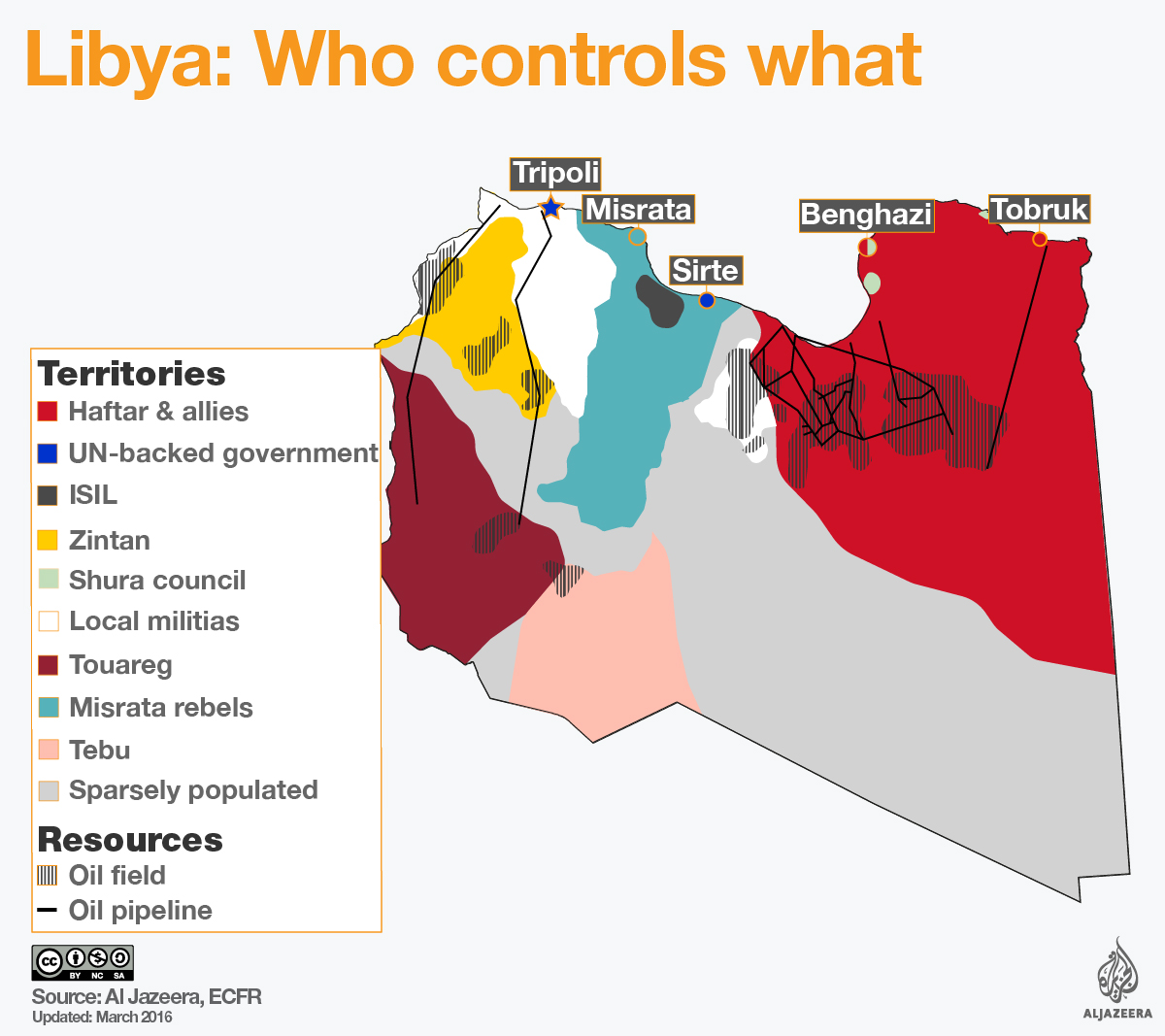
Turkey’s pledge of military support, which Libya formally accepted last week, comes at a critical time in the battle between the United Nations-recognized government and the self-proclaimed Libyan National Army, which just renewed its assault on the city of Misrata and again demanded that Turkish-backed militias withdraw from the capital city of Tripoli. Both the United States and the European Union expressed concern at the escalation in Libya, and especially international involvement on both sides—which includes ongoing violations of the U.N. arms embargo on Libya.
Turkey’s double-barreled approach to Libya is a response to its growing diplomatic isolation in the region. Turkey has fallen out with the United States over its incursion into northern Syria and is still at odds with Saudi Arabia over the murder of a journalist in a Saudi consulate in Turkey. Turkey is on the opposite side of Egypt, the United Arab Emirates, and Russia in Libya. It is battling Egypt for influence around the Red Sea and sees a constellation of states such as Israel, Greece, Cyprus, and Egypt teaming up to exploit the region’s energy leaving Turkey in the cold.
From Ankara’s perspective, the pair of agreements with Libya potentially offer a way to shape the region’s future in its own favor—or at least prevent what it sees as the unacceptable rise in influence of rivals like Russia and Egypt in the Mediterranean.
“Turkey’s recent agreement with Libya’s legitimate government about maritime delimitation line and defense cooperation deal is crucial for protecting Turkey’s and Libya’s rights in the Eastern Mediterranean region,” said a Monday column in the government-friendly Daily Sabah newspaper.
The link between military support for Libya and Turkey’s geopolitical position in the region was the declaration, formalized earlier this month, of a new maritime boundary line between Turkey and Libya. As a result of that bilateral agreement, Turkey is laying claim to a huge chunk of the eastern Mediterranean—an area that includes large reservoirs of natural gas that Egypt, Israel, Cyprus, and even Lebanon are racing to exploit.
For several years, Turkey has pushed back against efforts by Cyprus to exploit those gas discoveries by harassing drill ships operating there with Turkish naval vessels and sending its own drilling ships into Cypriot waters. By laying legal claim to a big chunk of the Mediterranean—especially between Greece and Egypt—even if only on paper, Ankara hopes to forestall those other countries’ claims to the resources. Turkish President Recep Tayyip Erdogan on Monday insisted he won’t back down from his new Libyan deals, despite the protests from other countries.
The energy question in the eastern Mediterranean is taking on new urgency from Ankara’s point of view. The United States passed legislation last week that will boost U.S. support for energy development in the eastern Mediterranean, as well as greater security assistance for Greece and Cyprus.
Perhaps more importantly, after years of talking about it, Greece, Israel, and Cyprus are getting closer to a deal on a pipeline that would carry natural gas right through those disputed waters, via Crete, to Greece and Italy. On Sunday, the three countries said they could formalize an intergovernmental agreement on the EastMed pipeline as soon as Jan. 2, though crucially Italy hasn’t yet indicated that it will sign the accord.
The project would be the culmination of the so-called Eastern Mediterranean Gas Forum that Egypt, Israel, Cyprus, and Greece signed earlier this year—pointedly excluding Turkey from the club.
“I think that Turkey is really concerned about this ‘Club Med.’ I think it was a strategic mistake on those countries’ part—if you need regional cooperation, you don’t just include your buddies,” said Brenda Shaffer, an energy expert at Georgetown University. “I think Turkey wants to be part of the picture.”
Ankara sees the new agreement as a way to fence off disputed areas of the eastern Mediterranean and possibly prevent other countries from taking advantage of the region’s resources without counting on Turkey.
“I would say it is a masterful stroke by Ankara, because from its point of view, there was this axis of adversaries in the eastern Mediterranean building a maritime wall,” said Soner Cagaptay, the director of the Turkish Research Program at the Washington Institute for Near East Policy. If the new maritime boundary is accepted, and if Libya’s legitimate government survives, “it would allow Turkey to block that maritime wall.”
The first problem for Ankara is that the maritime agreement it sees as vital to preventing encirclement by its neighbors was signed with Libya’s Government of National Accord, which continues to face an armed assault on its survival. For the agreement to survive, so does that government—which means both Turkey on one side and Egypt and the UAE on the other will likely redouble their support for the warring factions in Libya.
“It all hinges on what happens in Libya. If that government falls, the maritime treaty is out,” Cagaptay said. “So now, Libya is an even more serious theater for proxy competition.”
A potentially bigger problem for Ankara, legal experts say, is that the maritime boundary agreement with Libya is at odds with international law and unlikely to be observed by any of the other countries in the region.
“The Turkish claim is not aligned with the established principles of international law,” said Yunus Emre Acikgonul, a former Turkish diplomat and expert in maritime boundary law. The Turkish government’s claims that this creative legal approach grants them a wide swath of water don’t hold up to scrutiny, he said.
“You cannot gain maritime area through a novel approach, faits accomplis, or just because you acted first. There are principles in international law, and this agreement blatantly contradicts the established case law.”
In particular, a bilateral agreement that infringes on other states’ rights—in this case, essentially writing Crete out of the map almost entirely—is at odds with international law. “Parties cannot delimit overlapping boundaries unilaterally, at the exclusion of other affected states,” Acikgonul said.
And there are other problems: The divided Libyan government includes a parliament in rebel-held Tobruk, which won’t ratify an agreement the other government signed. Without legislative approval, the maritime agreement cannot enter into force, he said.
Whether the Turkish government really believes its own dubious legal claim or is just using it for political purposes, it’s likely to be counterproductive. “This agreement does not strengthen Turkey’s position, but rather further isolates it from neighboring countries and international fora,” he said.
Ultimately, Acikgonul said, the questionable maritime claim is fruit of both a Turkish foreign ministry purged of most of its legal experts after the 2016 coup attempt—as he himself was—and the continued drift in Turkish policymaking toward satisfying Erdogan’s desire for a political victory that will resonate with his nationalist base at home.
“The agreement also indicates that Turkey’s decision-making process has been shifting on a more adventurous and nationalistic axis,” he said.
Still, other countries in the region are taking Turkey’s legal gambit—already rejected by the European Union as incompatible with international law—seriously enough to push back in earnest. The Greek foreign minister just went to visit the other Libyan government and is on his way to Egypt. Meanwhile, Cyprus wants the other Eastern Mediterranean Gas Forum countries to launch a diplomatic offensive against Turkey’s audacious new claims, and on Monday it enlisted Jordan’s help in that campaign.
A diplomatic solution is the most likely, because both Turkey and Greece would stand to lose in any judicial process. Greece has excessive maritime claims of its own near Turkey’s coast, and any verdict Turkey agreed to would amount to recognizing Cyprus as a state—something it refuses to do.
Meanwhile, the scramble to tap the region’s energy riches continues. Turkey continues to send drilling ships to explore in blocks that Cyprus has already licensed to European companies, and it just dispatched a military drone to northern Cyprus to fly over its ships. Some companies, such as Italy’s Eni, have called off operations rather than stare down Turkish naval vessels. Others, such as ExxonMobil, which is drilling in a different area, have pressed ahead despite Turkish saber-rattling. The EU has prepared, but not yet unleashed, sanctions against Turkey for drilling in Cypriot waters.
Looking ahead, there is a real risk that the battle to extract natural gas from the seabed could end up igniting actual conflict among the eastern Mediterranean neighbors rather than fueling rapprochement.
The fact that the driving force behind the new maritime boundary seems to have come not from the denuded foreign ministry but rather from the Turkish navy suggests that the military is playing a bigger role in shaping Turkey’s approach to its Mediterranean problems. Turkey’s foreign minister recently made clear that Ankara would use force, if necessary, to deter others from drilling for gas in waters it considers its own.
“I don’t think either side will escalate intentionally, but if there is a dogfight where Cyprus or Turkey loses a ship or a plane, that could result in escalation that cannot be prevented,” Cagaptay, of the Washington Institute for Near East Policy, said.
Keith Johnson is a senior staff writer at Foreign Policy. Twitter: @KFJ_FP
Yes. ANOTHER. Just like Libya and Benghazi and even our OWN now. The video show proof and the deep-state is not completely partisan, although the majority is being controlled on the Democrat side.
I have tried to embed the code from the site but WordPress won’t let me
here’s the link – it’s absolutely worth you time to watch it.






 Politics Religion and Family
COMMENTS